
How many lumens for a living room: the numbers, room size by room size
Most living rooms have the same problem: one ceiling light in the middle of the room and nothing else. In the evening you switch it on and the room goes flat — everything is lit equally, the shadows disappear, and the space looks smaller than it is.
This isn't a matter of taste. It's a matter of numbers and layers.
The starting figure: 100–200 lumens per square metre
For a living room, the general benchmark is 100 to 200 lumens per square metre. A 25 m² living room therefore needs somewhere between 2,500 and 5,000 lumens in total.
| Living room size | Total lumens needed |
|---|---|
| 15 m² · small | 1,500 – 3,000 lm |
| 20 m² | 2,000 – 4,000 lm |
| 25 m² | 2,500 – 5,000 lm |
| 30 m² | 3,000 – 6,000 lm |
| 40 m² · large | 4,000 – 8,000 lm |
The range is deliberately wide. Rooms with white walls and pale furniture sit comfortably at the lower end. Rooms with dark walls, panelling or walnut furniture swallow light and need the upper figures — a dark room can call for 30 to 40% more than a white one.
Worth noting: a standard 60 W-equivalent bulb gives around 800 lumens. So 2,500 lumens means three bulbs of that kind. Not one, however powerful.
Why the ceiling light alone never works
Even if you put a 3,000-lumen bulb in the ceiling fitting, the room will look wrong. The light comes from a single point, from above, and flattens everything under it. There is no shadow to give depth.
Good lighting is built in three layers:
Ambient light — the ceiling light or downlights. Roughly 40% of the total lumens. Its job is to stop you tripping over things, not to create atmosphere.
Task light — a floor lamp by the armchair, a table lamp by the sofa, reading light. Another 30–40%. This is the light you actually use in the evening.
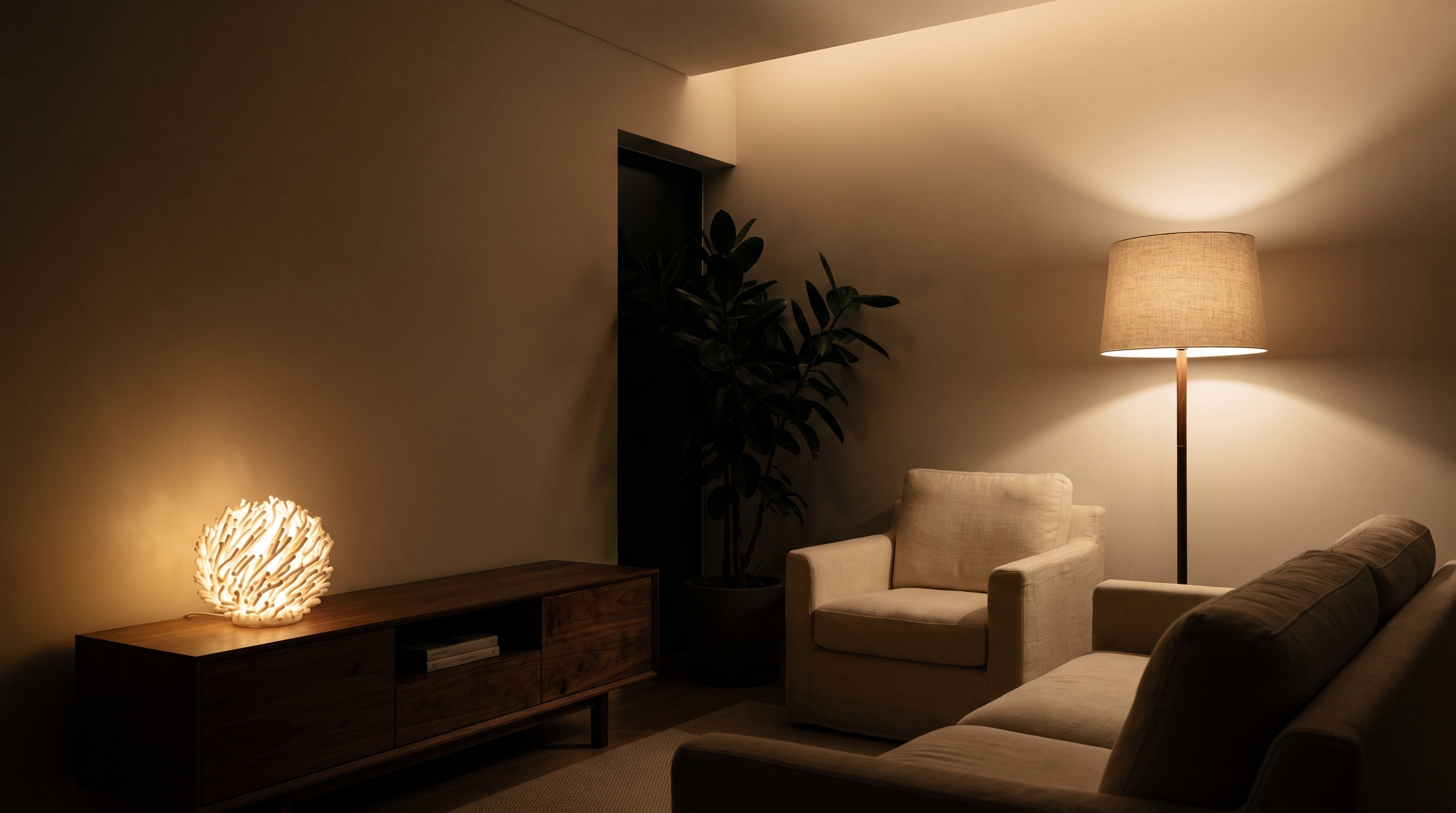
Accent light — the remaining 20–30%. A glowing object on a console, a lamp that draws on the wall, light behind a plant. It illuminates nothing useful. It makes the room look larger and deeper.
A 25 m² living room, divided properly: about 1,400 lumens overhead, 1,200 in the seating zones, 600–800 on accents.
Colour temperature: 2700 K in the evening, no exceptions
Choose 2700–3000 K for a living room. That's warm, slightly yellow light, close to a classic incandescent bulb.
Above 4000 K you get cool, bluish light — right for a kitchen or a study, wrong for the room you relax in. A living room at 5000 K looks like a waiting room, however expensive the furniture.
If you have several fittings in the same room, keep them all at the same temperature. Mixing warm and cool is the most visible lighting mistake there is, even though most people can't name it.
The layer most often missing
Of the three, accent is the one almost nobody adds. And it's the cheapest — no installation, no electrician, just a socket.
A glowing object on a console or a bookshelf does two things at once: it adds lumens where the room is dark, and it becomes something to look at in its own right when switched off.
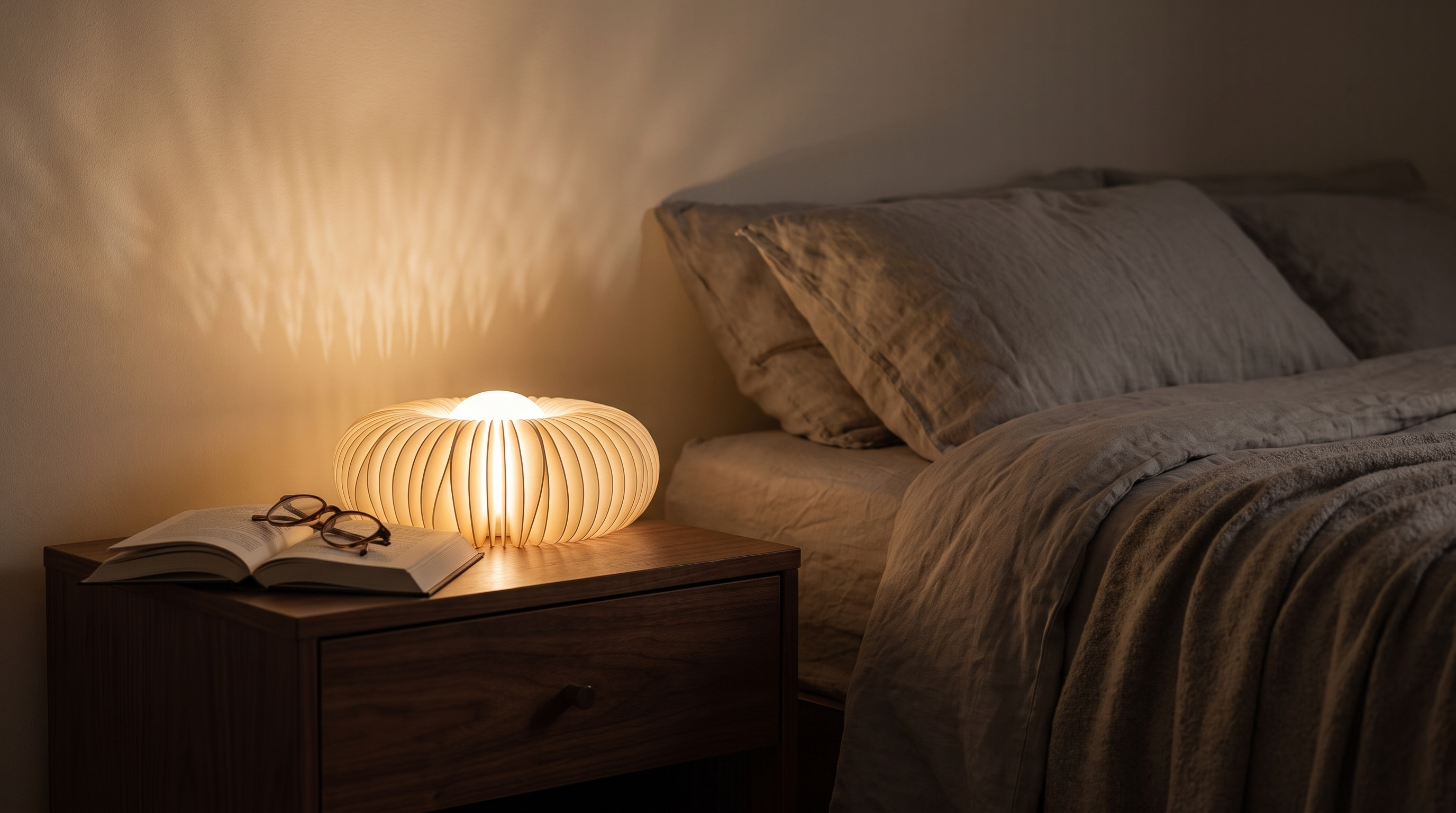
The lamps in Collection O are built for exactly this layer — 3D-printed structures that light passes through rather than past, so they draw on the surrounding walls. Coral and Growth have a dense texture and throw a rich pattern. Midnight Sun is low and wide, suited to a console under a mirror. For a smaller corner, Ocean Petals runs on USB, so you can move it anywhere.
In short
- 100–200 lm/m², towards the top of the range if the walls are dark
- Split: 40% ambient, 30–40% task, 20–30% accent
- 2700–3000 K, the same temperature across every fitting
- At least three sources in a living room, whatever its size
- A dimmer on the main source
If you change one thing tonight, add a third light source, low down, in a dark corner. It's the biggest difference for the least effort.

Leave a comment
This site is protected by hCaptcha and the hCaptcha Privacy Policy and Terms of Service apply.