
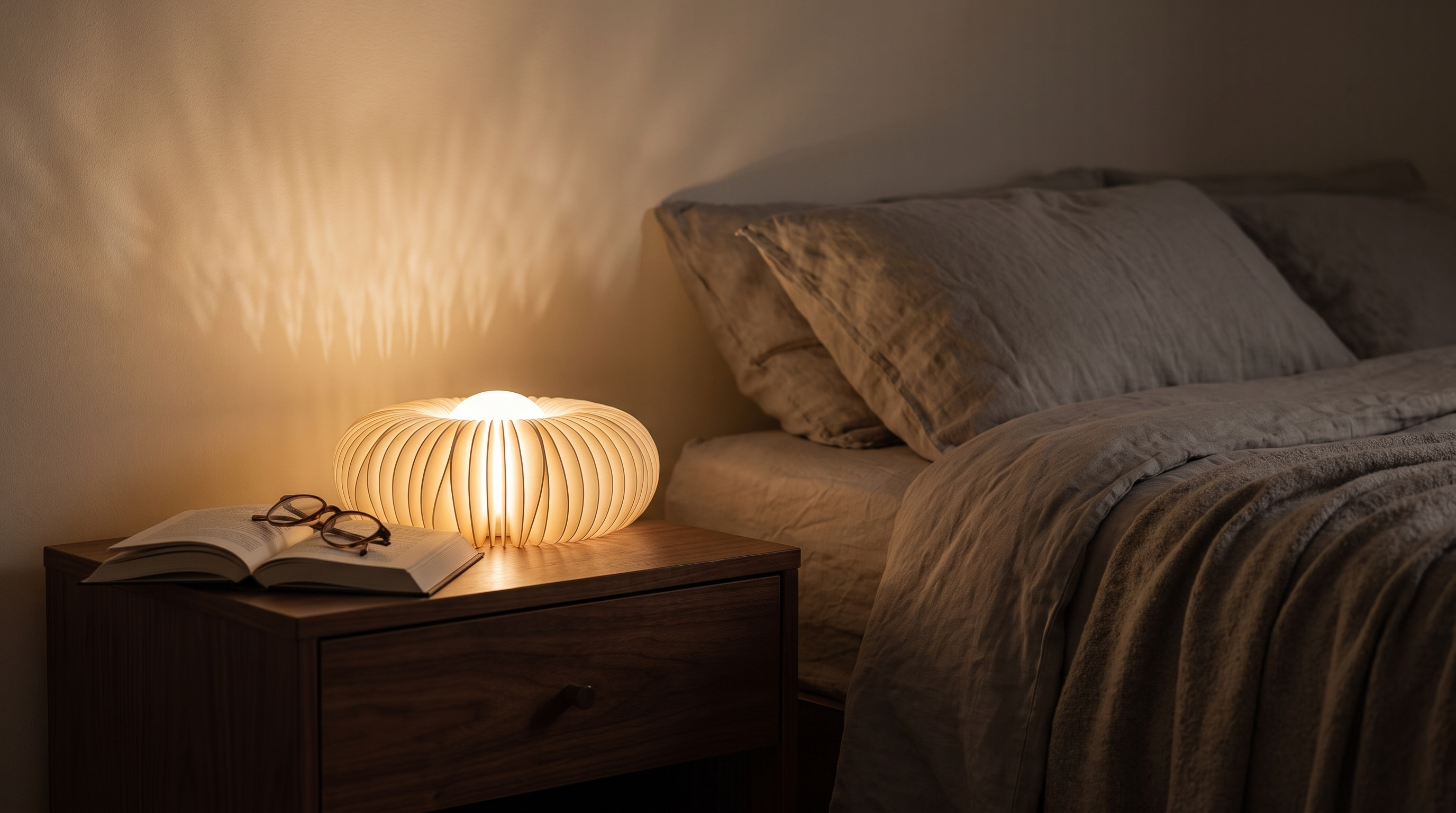
Bedside lamp for reading in bed: how to choose one that doesn't dazzle you
Most bedside lamps are bought for how they look in daylight and used at night, when they behave completely differently. That's where the disappointment comes from: the lamp is beautiful, but it dazzles you, or it lights the ceiling instead of the book, or it keeps your partner awake.
There are four things to check before you order.
1. Height: the shade at shoulder level when you're sitting up
The practical rule: the bottom edge of the shade should sit roughly at your shoulder when you are propped up in bed.
Higher and you see the bulb directly and it dazzles you. Lower and the light falls only on the duvet, leaving the page in shadow.
Translated into centimetres: with a standard bedside table of 55–60 cm, the lamp should be 40–50 cm tall overall. If the table is lower, you need a taller lamp, not the other way round.
2. The bulb must not be visible from the reading position
Sit on the edge of the bed and look towards the lamp. If you can see the bulb or the LED source directly, you'll see it at night too, in the dark, when your pupil is dilated. It's ten times more irritating then.
A shade that drops below the level of the source solves this. So does a dense structure that breaks the light up before letting it out.
3. Light output: 400–600 lumens at 2700 K
For reading you need 400–600 lumens — a 5–7 W LED. Less tires the eyes; more turns the bedroom into a corridor.
Colour temperature: 2700 K or lower. The bedroom is the one room where it's worth going down towards 2200 K, almost candle colour. Cool light in the evening tells the brain it's morning and makes falling asleep harder — that isn't marketing, it's the effect on melatonin.
A dimmer matters more here than in any other room. Reading light and pre-sleep light are two different things.
4. How it looks switched off
A bedside lamp sits on the table twenty-four hours a day and is lit for perhaps two. The rest of the time it's an object you see every time you walk into the room.
That's the argument for a shape that stands on its own without light — an object, not an accessory.
What a structure the light passes through changes
A fabric shade gives a soft pool of light. An open structure lets light travel through it and projects a pattern onto the wall and the ceiling.
In a bedroom at night, with a single source lit, the difference is large: instead of a circle of light, you get a whole wall that changes.
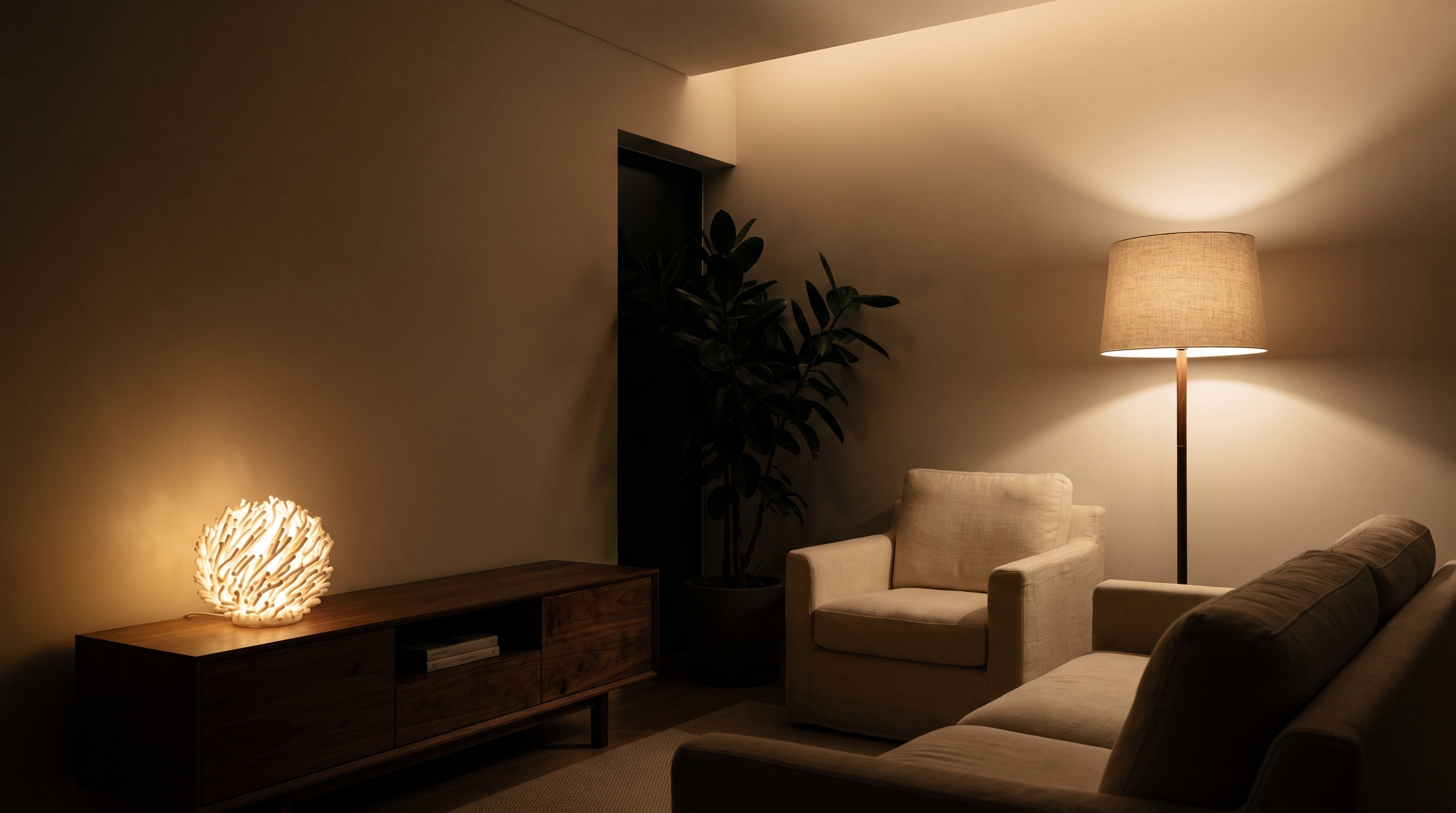
From Collection O, several suit a bedside table well. Dune and Wind are around 25 cm and give a warm light filtered through layers. Ocean Petals is smaller, runs on USB, and every piece comes out with a different colour pattern. Midnight Sun is low and wide — useful if the bedside table is narrow and you don't want anything tall next to your head.
All are printed one at a time, with the bulb included, at 2700 K.
In short
- Shade at shoulder level when you're propped up
- The bulb not visible from the reading position
- 400–600 lm, at 2700 K or lower
- A dimmer — this is the room where it matters most
- Think about it switched off too: you see it ten times more often than lit

Leave a comment
This site is protected by hCaptcha and the hCaptcha Privacy Policy and Terms of Service apply.